Protocol
Physics impact
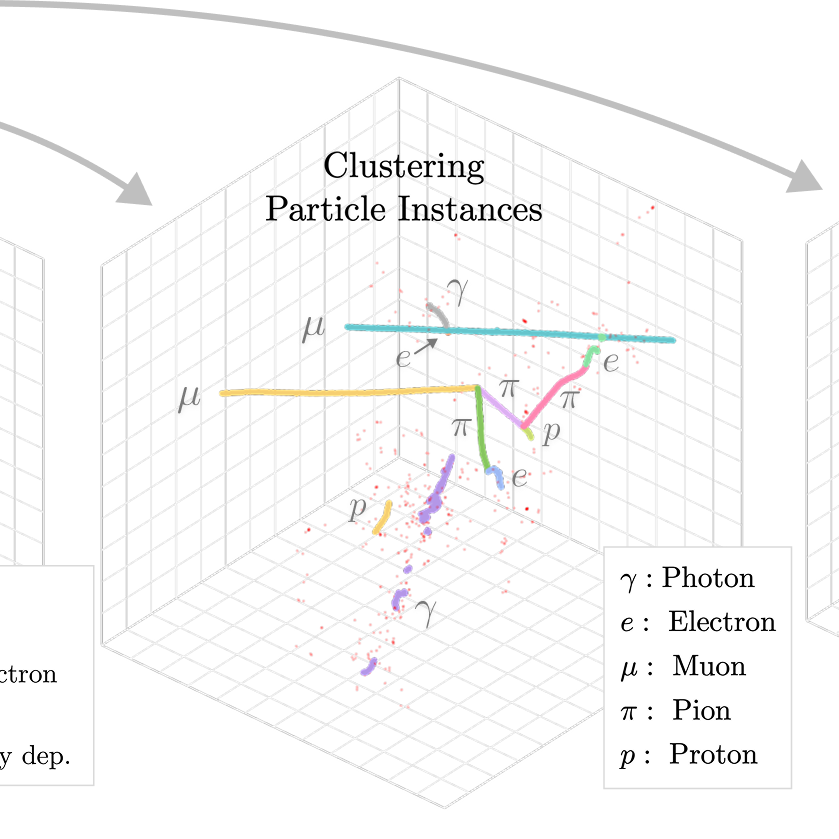
Panoptic segmentation turns dense detector activity into structured physics objects while preserving particle identity and interaction context for downstream reconstruction. The task borrows the semantic-plus-instance framing used in computer vision (Kirillov et al. 2019) but asks models to respect detector geometry, charge deposition, and sparse event topology.
Submission shape
A valid entry should be reproducible, versioned, and evaluable on a held-out split without private post-processing. For an event with predicted clusters \(\hat{C}\) and reference clusters \(C\), the leaderboard will report the adjusted Rand index,
\[ \mathrm{ARI} = \frac{\sum_{ij}\binom{n_{ij}}{2} - \left[\sum_i \binom{a_i}{2}\sum_j \binom{b_j}{2}\right] / \binom{n}{2}} {\frac{1}{2}\left[\sum_i \binom{a_i}{2} + \sum_j \binom{b_j}{2}\right] - \left[\sum_i \binom{a_i}{2}\sum_j \binom{b_j}{2}\right] / \binom{n}{2}}. \]
See
Leaderboard
Until the challenge opens, the baseline score is the reference value and the leaderboard is treated as provisional. The first public protocol should include a frozen validation container, a baseline model card, and an explicit policy for detector-specific calibration features.